A World of Color: How Global Art Traditions Are Coming Alive in Digital Coloring
Somewhere in a suburb of Columbus, Ohio, a ten-year-old is carefully filling in the interlocking stars of an Islamic geometric pattern on a tablet screen. In Portland, a retired teacher is downloading a printable inspired by Ndebele beadwork from South Africa. And in a classroom in Austin, a third-grade teacher is using mandala coloring pages to open a conversation about Hindu and Buddhist traditions.
Digital coloring platforms have quietly become one of the most accessible gateways to world art — and that's both exciting and worth thinking about carefully.
A Canvas With No Borders
For most of human history, exposure to art from other cultures required travel, museum access, or at minimum a pretty good library. Today, a coloring page can introduce a child in rural Nebraska to the visual language of Japanese mon crests or the bold, rhythmic patterns of Indigenous Navajo weaving — all before lunch.
Platforms like Coloring Fun have leaned into this global dimension deliberately, offering design collections that pull from traditions spanning every continent. And the appeal isn't hard to understand. These patterns are visually stunning. They're often intricate enough to be genuinely engaging for older kids and adults. And they carry centuries of human creativity in every line.
But the best versions of this kind of content don't just offer pretty pictures. They offer context.
Mandalas: More Than a Pretty Circle
Few design forms have traveled as far — or been as thoroughly separated from their origins — as the mandala. In Sanskrit, the word literally means "circle," and in Hindu and Tibetan Buddhist traditions, mandalas are sacred diagrams representing the cosmos, used in meditation and ritual.
Today, mandala coloring pages are everywhere. They're in bookstores, on coloring apps, and printed on everything from journals to yoga mats. For many Americans, they've become synonymous with relaxation and mindfulness — which isn't entirely wrong. But educators and cultural practitioners often point out that the spiritual dimension gets lost in translation.
"The mandala is a living practice in many traditions," says Priya Anand, a South Asian art educator based in the San Francisco Bay Area who consults with schools on culturally responsive arts curriculum. "When kids color one, that's a wonderful thing — but the opportunity is so much richer if they also learn why these forms exist, what they mean to the people who created them."
The takeaway for parents and educators isn't to avoid mandalas — it's to add the story alongside the coloring page.
The Geometry of Devotion: Islamic Pattern Design
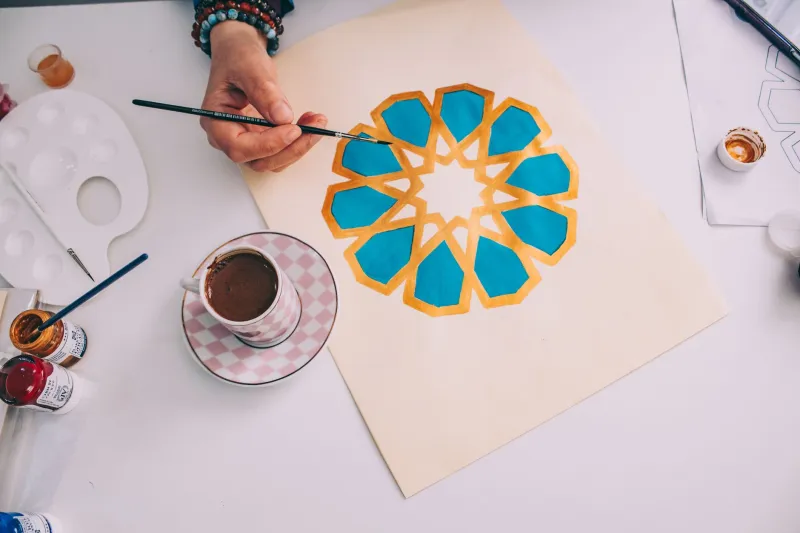
Islamic geometric art is one of the most mathematically sophisticated visual traditions in human history. Developed over centuries across the Middle East, Central Asia, and North Africa, these patterns — built from repeating stars, polygons, and interlacing lines — were designed to suggest the infinite nature of creation without depicting living figures (in keeping with certain interpretations of Islamic artistic tradition).
The complexity of these designs makes them naturally compelling for digital coloring. The repetition creates a meditative rhythm. The precision rewards patience. And the results, when colored thoughtfully, are genuinely breathtaking.
Artist and educator Kareem Saleh, who teaches Islamic art history and pattern design at a community college in Chicago, sees digital coloring as a legitimate entry point — with some caveats.
"These patterns have deep spiritual meaning for a lot of people," he explains. "Engaging with them respectfully means understanding that. It doesn't mean you can't color them if you're not Muslim — art travels, that's what it does. But there's a difference between appreciating something and just consuming it."
He recommends that platforms accompany these designs with brief, accurate cultural notes — something Coloring Fun's design collections increasingly include.
African Textile Traditions: Pattern as Language
West African textile traditions — from Ghanaian kente cloth to Nigerian aso-oke — use pattern and color not just decoratively but communicatively. Specific color combinations and geometric sequences carry meaning: royalty, mourning, celebration, identity.
Adapting these traditions for coloring pages is tricky territory, and cultural educators are thoughtful about the distinction between appreciation and appropriation. The key question, they say, is whether the cultural context travels with the design.
"If a child colors a pattern inspired by kente and learns that yellow represents gold and royalty, that blue represents love and harmony — that's a learning moment," says Adaeze Okonkwo, a Nigerian-American textile artist and educator based in Atlanta. "If they just color it because it looks cool with no context, something important is missing."
She's not opposed to these designs appearing on digital platforms — quite the opposite. "I want kids to engage with African art. I want them to see its sophistication and beauty. I just want the story to come with it."
Japanese Motifs and the Art of Negative Space
Japanese visual traditions bring a different set of principles to the table — ones that can genuinely reshape how kids and adults think about design. Concepts like ma (negative space), seasonal symbolism (cherry blossoms for spring, maple leaves for autumn), and the aesthetic of wabi-sabi (finding beauty in imperfection) are embedded in Japanese pattern work in ways that offer rich discussion points.
For digital coloring specifically, Japanese motifs often invite a more restrained, deliberate approach to color. Less is frequently more. The empty space is part of the design. That's a genuinely different creative philosophy than the "fill every inch" approach that dominates a lot of Western coloring aesthetics — and experiencing it firsthand through a coloring page is a surprisingly effective way to internalize it.
How to Make It Meaningful
Whether you're a parent, a teacher, or someone who just loves exploring global designs on a coloring platform, here are a few ways to deepen the experience:
Read the story first. Before coloring a culturally rooted design, take five minutes to look up its origins. A quick search on a pattern's cultural background can transform a coloring session into a genuine learning moment.
Talk about color symbolism. Many traditional art forms use color with specific symbolic intent. Exploring why certain colors were chosen — and what they meant — adds a layer of meaning to every choice you make on the page.
Connect it to the map. For kids especially, pairing a coloring page with a quick look at a world map builds geographic and cultural awareness in a low-pressure, engaging way.
Seek out voices from the culture. If a design comes from a specific tradition, try to find books, videos, or resources created by people from that community. It's the difference between learning about a culture and learning from it.
Color as Connection
At its best, global-inspired digital coloring isn't about exoticizing other cultures or stripping their art of meaning. It's about connection — the recognition that humans everywhere have used color, pattern, and line to make sense of the world, express identity, and create beauty.
When a kid in Kansas colors a Huichol yarn painting design or a geometric Berber textile pattern, something small but real happens: the world gets a little larger, and a little more familiar, all at once.
That's worth a lot. And it starts with a single colored line.