Your Brain on Color: What Science Says About Coloring and Stress Relief
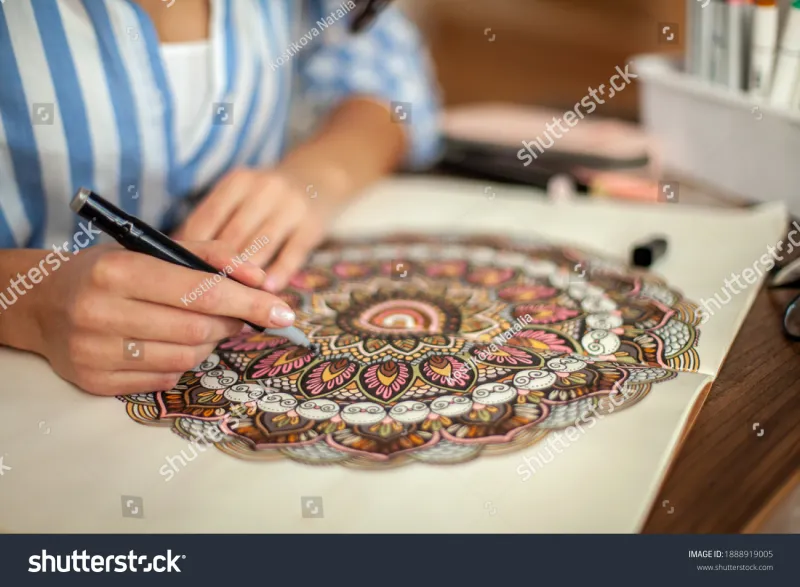
Photo: adult woman coloring mandala design with colored pencils at peaceful desk, via www.shutterstock.com
Remember when adult coloring books started showing up everywhere around 2015? People were grabbing them off bookstore shelves like they were selling out of concert tickets. At the time, a lot of folks wrote it off as a quirky trend. But here's the thing — that wave of interest wasn't random. Something real was happening, and neuroscientists have spent the better part of a decade figuring out exactly what.
Spoiler: your brain genuinely loves coloring. And not just in a "this is kind of relaxing" way. In a measurable, neurological, anxiety-reducing way.
What Actually Happens in Your Brain When You Color
Let's start with the basics. When you sit down and start filling in a design with color, your brain shifts gears. The amygdala — that almond-shaped cluster of neurons responsible for your fight-or-flight response — begins to quiet down. Think of it like turning the volume knob on your stress response from a blaring 10 to a comfortable 3.
Dr. Stan Rodski, a neuropsychologist who has studied the effects of coloring on the brain, found that the activity triggers relaxation responses similar to those produced by meditation. That's a pretty big deal. Meditation takes practice, patience, and a willingness to sit still with your own thoughts. Coloring? You just need a page and something to color with.
The reason for this effect comes down to focus. Coloring requires just enough mental engagement to pull your attention away from anxious thoughts without demanding so much brainpower that it becomes stressful itself. Psychologists call this a "flow state" — that sweet spot of engagement where you're absorbed in what you're doing but not overwhelmed by it. Flow states are consistently linked to lower cortisol levels (cortisol being the hormone most associated with stress).
The Mindfulness Connection
Here's where it gets even more interesting. Mindfulness — the practice of staying present in the moment — is one of the most well-researched tools for managing anxiety and depression. The problem is, a lot of people struggle to meditate in the traditional sense. Sitting quietly with your eyes closed, focusing on your breath, not letting your mind wander to your grocery list? Genuinely hard for most people.
Coloring acts as what researchers sometimes call "active mindfulness." Your hands are busy, your eyes are focused on the page in front of you, and your brain has a gentle, non-threatening task to concentrate on. A 2017 study published in the journal Art Therapy found that just 20 minutes of coloring significantly reduced anxiety in college students. Another study from the American Journal of Public Health highlighted creative activities — including visual arts — as meaningful contributors to emotional resilience.
Basically, you don't have to be a meditating monk to get the mental health benefits of mindfulness. You just need a good design and your favorite set of markers.
So Which Designs Actually Work Best?
Not all coloring pages are created equal when it comes to stress relief. Research and anecdotal evidence from therapists and art therapy practitioners point to a few specific design types that tend to be most effective.
Mandalas: The Gold Standard
If you've spent any time on Coloring Fun, you've probably noticed we have a whole section dedicated to mandalas — and there's a solid reason for that. Mandalas are circular, symmetrical designs that originated in Hindu and Buddhist traditions as symbols of the universe. Their geometric repetition makes them particularly well-suited for inducing a meditative state.
A study out of Drexel University specifically compared coloring mandalas versus coloring plaid patterns versus free drawing. The mandala group showed the greatest reduction in anxiety. Researchers believe the structured, symmetrical nature of mandalas gives the brain just enough pattern to follow without requiring creative decision-making, which can itself be a source of stress.
Nature Scenes: Gentle Engagement
Detailed nature illustrations — think forest scenes, botanical drawings, underwater landscapes — work well for people who find pure geometric patterns a little too repetitive. Nature imagery taps into what psychologist Rachel and Stephen Kaplan called "Attention Restoration Theory," the idea that natural environments (even depicted ones) help restore our capacity for focused attention.
Floral patterns, in particular, are a perennial favorite for good reason. They offer variety within structure — every petal is slightly different, but the overall design has a coherent flow. This keeps your brain gently engaged without tipping into overwhelm.
Abstract Patterns: Great for Letting Go
For people whose stress tends to stem from perfectionism or a need for control, abstract patterns can be surprisingly liberating. There's no "right" way to color an abstract design, which gives you permission to just play. Color outside the lines. Mix unexpected hues. No one's grading you.
This freedom can be its own form of stress relief — a reminder that not everything needs to be done perfectly.
Tips for Making Your Coloring Sessions Actually Work
Knowing the science is great, but turning that knowledge into a real habit takes a little intention. Here are a few evidence-backed ways to get the most out of your coloring time:
Put your phone face-down. Notifications are the enemy of flow states. Even the buzz of an incoming text can pull you out of that calm, focused headspace you're trying to build.
Set a timer for at least 20 minutes. The anxiety-reduction benefits in most studies kicked in around the 20-minute mark. A quick five-minute session might feel nice, but it probably won't move the needle much on your stress levels.
Choose your colors intuitively. Don't overthink it. Grab what feels right. Research suggests that the act of making small, low-stakes decisions (like picking a color) can actually build a sense of agency and calm.
Create a ritual around it. Make yourself a cup of tea, put on some ambient music, find a comfortable spot. The ritual itself signals to your nervous system that it's time to relax.
Try our digital coloring tools first. If you're new to coloring or just want to experiment without committing to a printed page, Coloring Fun's online coloring games let you test different designs and color palettes before you ever pick up a pencil. It's a great low-pressure way to find the styles that resonate with you most.
The Bottom Line
Adult coloring isn't a gimmick, and it's definitely not just for people who are "artsy." It's a genuinely accessible, research-supported tool for managing everyday stress and anxiety. Whether you're drawn to the meditative geometry of mandalas, the organic beauty of nature scenes, or the freewheeling fun of abstract designs, there's a coloring page out there that your brain will thank you for.
And honestly? The best design is the one you actually sit down and color. So go find one you love — we've got plenty to choose from right here at Coloring Fun — and give your brain the break it's been asking for.