How Coloring Intricate Patterns Is Secretly Training Your Teen's Brain to Make Smarter Choices
Parenting a teenager can feel like watching someone navigate a minefield while wearing noise-canceling headphones. Impulsive choices, snap reactions, and the occasional "I don't know, I just did it" explanation are all part of the deal. But what if one of the most effective tools for helping teens slow down and think things through was already sitting in your craft drawer?
Researchers and educators are paying closer attention to how structured creative activities — specifically, coloring complex, repeating patterns — influence the developing teenage brain. And the findings are genuinely surprising.
The Teenage Brain Is a Work in Progress (Literally)
Here's something worth knowing: the prefrontal cortex, the part of the brain responsible for planning, weighing consequences, and resisting impulse, doesn't fully mature until the mid-twenties. For teenagers, this means decision-making is often handled more by the emotional, reactive limbic system than by the cool, calculating frontal regions adults rely on.
That's not a character flaw — it's biology. But it does mean that teens genuinely benefit from activities that give the prefrontal cortex a regular workout. And that's where pattern-based coloring enters the picture in a surprisingly meaningful way.
What Happens in the Brain During Pattern Coloring
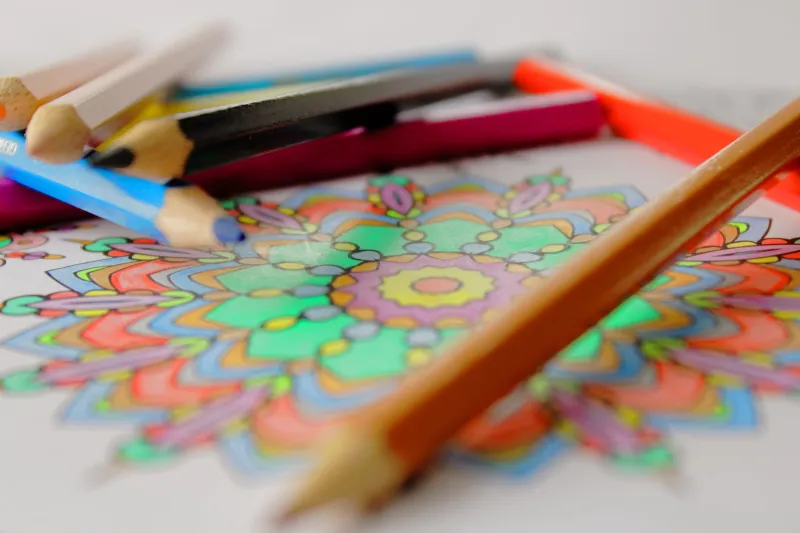
When someone sits down with a mandala or a geometric tessellation — those intricate, interlocking designs that repeat across the page — the brain doesn't just switch to autopilot. It actually gets busy.
Pattern recognition is one of the brain's most fundamental and energy-intensive tasks. Identifying repeating sequences, predicting what comes next, and adjusting behavior based on those predictions are all core components of what neuroscientists call executive function. These are the same cognitive skills that underpin careful decision-making.
A study published in Art Therapy: Journal of the American Art Therapy Association found that coloring structured designs like mandalas significantly reduced anxiety and increased focus compared to free-form drawing. Reduced anxiety matters here because when the brain isn't in a state of low-level panic, the prefrontal cortex can actually do its job — including helping a person think through choices more carefully.
Coloring patterns also demands a kind of sequential logic. Before you fill in a section, you're already thinking ahead: If I use dark blue here, what happens to the adjacent triangle? Does the balance of the whole design shift? That internal dialogue — even if it happens wordlessly — is systematic thinking in action.
The Decision-Making Link Is More Direct Than You'd Expect
Here's the part that tends to surprise parents: the cognitive habits built during pattern coloring don't stay locked inside the activity. They transfer.
Neuroplasticity — the brain's ability to rewire itself based on repeated experience — means that consistently practicing a type of thinking strengthens the neural pathways associated with it. When a teen regularly engages in activities that require sequential logic, anticipating outcomes, and evaluating options before acting, those mental muscles get stronger across the board.
Think of it like this: you wouldn't expect someone who runs five miles a day to only be fit for running. Cardiovascular strength carries over into everything. Similarly, the systematic thinking practiced during an hour with a geometric coloring page doesn't clock out when your teen closes the sketchbook.
Dr. Stan Rodski, an Australian neuroscientist who has studied the effects of coloring on brain function, has pointed to the repetitive, focused nature of pattern coloring as a key factor in its cognitive benefits — noting that it activates areas of the brain associated with logic and organization in ways that unstructured activities simply don't.
Mandalas, Tessellations, and Why the Design Type Matters
Not all coloring pages deliver the same cognitive punch. A simple cartoon outline is fun and has its own creative value, but it's the intricate, repeating designs that really push the brain into that systematic mode.
Mandalas are particularly effective because of their radial symmetry. Every choice made in one section ripples outward — a color used in one quarter of the design needs to be considered in context of the whole. That's a pretty good metaphor for real-world decision-making, honestly.
Geometric tessellations — designs where shapes tile together without gaps or overlaps — require even more spatial reasoning. Teens working with these designs are essentially solving a visual puzzle in real time, which directly exercises the kind of logical sequencing that helps in everything from algebra to figuring out how to handle a conflict with a friend.
Celtic knotwork and fractal-inspired designs add another layer: the ability to track complexity without losing the thread. Following an intricate knot pattern while coloring it trains attention and working memory simultaneously.
On Coloring Fun, we've got a solid library of all three — printable versions for your kitchen table sessions and digital versions for teens who prefer working on a tablet or laptop.
Practical Ways to Make This Work at Home
Getting a teenager to sit down with a coloring page isn't always as simple as sliding one across the table. Here are a few approaches that actually tend to work:
Frame it as downtime, not homework. The moment a creative activity feels like an assignment, it loses its appeal. Keep it low-pressure. Leave a coloring page and a fresh set of colored pencils somewhere accessible and let curiosity do the work.
Do it alongside them. Teens are more likely to stick with an activity when a parent or older sibling is genuinely engaged in it too — not supervising, but actually participating. Pick a pattern for yourself and sit at the same table.
Talk about the choices, not the outcome. While you're coloring, ask open-ended questions: Why did you go with that color there? What are you thinking about doing with this section? This verbalizes the internal decision-making process and reinforces it.
Go digital when it fits. Some teens respond much better to screen-based tools. Digital coloring platforms let you undo decisions, experiment freely, and try out multiple color schemes — which actually adds another layer of intentional choice-making to the activity.
Make it a low-stakes experiment. Encourage your teen to try a design they find genuinely challenging. The mild frustration of navigating a complex pattern — and the satisfaction of working through it — builds exactly the kind of resilience and persistence that carries over into bigger decisions.
The Bigger Picture
We spend a lot of energy trying to teach teenagers good judgment through conversation, rules, and consequences. And those things matter. But the brain also learns by doing — by practicing the actual mechanics of careful, sequential thinking over and over until they become second nature.
Coloring intricate patterns isn't a magic fix. But it's a genuinely enjoyable, low-stakes way to give the teenage brain regular practice at something it badly needs: slowing down, looking at the whole picture, and making thoughtful choices one step at a time.
And honestly? The finished mandala looks pretty great on the fridge, too.