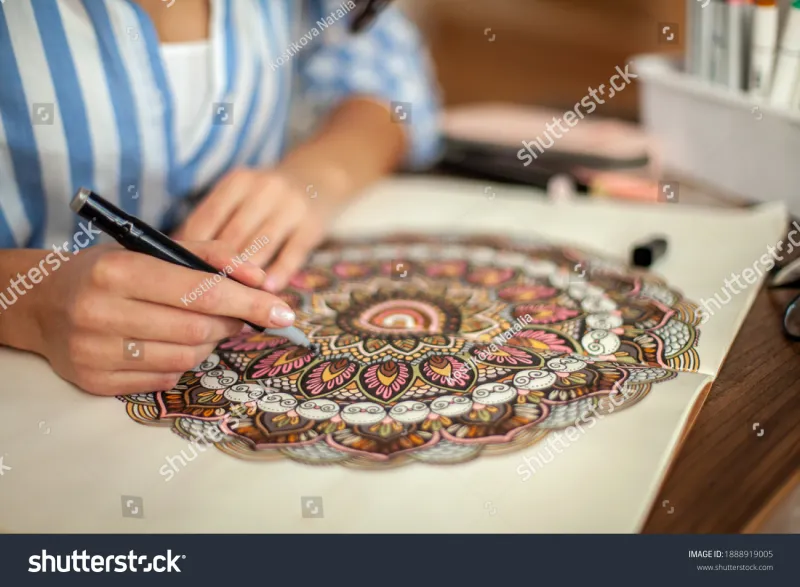
Why Finishing a Coloring Page Feels So Good: The Science Behind the Satisfaction

Photo: Baldwin Saintilus from USA, CC BY 2.0, via Wikimedia Commons
There's something quietly powerful about coloring in that last section of a page and setting down your stylus or colored pencil. It turns out the good feeling you get isn't just in your head — well, actually, it is, and science has a lot to say about it. We dug into the psychology of completion and why finishing a coloring project might be one of the simplest mood boosters you're not taking seriously enough.
That Little Rush Is Very Real
You know that warm, almost fizzy feeling when you finish something? Psychologists call it a "completion response," and it's tied directly to how your brain processes reward. When you wrap up a task — any task, from sending a tricky email to coloring the final petal on a mandala — your brain releases a small hit of dopamine, the same neurotransmitter involved in motivation and pleasure.
Dr. Renee Albrecht, a child and developmental psychologist based in Austin, Texas, explains it this way: "For kids especially, the brain is still building its reward circuitry. Completing something tangible, something they can hold up and say 'I did this,' creates a really clear feedback loop. They learn that effort leads to a result, and that result feels good. That's foundational stuff."
For adults, the mechanics are similar, but the context often matters even more. In a world where most of our work — emails, spreadsheets, ongoing projects — never really feels done, a coloring page offers something rare: a clear finish line.
The Power of the Small Win
There's a reason productivity coaches talk so much about "small wins." Research from Harvard Business School suggests that making progress, even on modest tasks, has an outsized effect on how we feel throughout the day. It builds momentum, boosts confidence, and reduces anxiety.
Coloring fits neatly into this framework. A single page is achievable in one sitting. It has a beginning, a middle, and an end. And when you're done, you have something to show for it.
Margie Tran, a 38-year-old graphic designer from Portland, Oregon, started using our digital coloring platform during a particularly stressful stretch at work. "I was juggling three major client projects that had no end in sight," she says. "I started coloring on my lunch break just to decompress. But what I didn't expect was how much it mattered to finish a page. I'd feel genuinely accomplished, even if it was just a little fox illustration. It sounds silly, but it reset my whole afternoon."
It doesn't sound silly at all. It sounds like exactly what the brain needs.
Goal-Setting in Disguise
Coloring is, at its core, a low-stakes form of goal-setting. When you open a new design — whether it's a printable mandala you've downloaded or a digital illustration on your tablet — you're implicitly committing to a goal: finish this. The path is clear. The tools are in your hands. The only variable is follow-through.
For children, this kind of structured creative play teaches persistence without the pressure. Dr. Albrecht notes that kids who regularly complete creative projects tend to develop stronger self-regulation skills over time. "They learn to tolerate the frustration of an unfinished thing," she says. "They learn to push through the middle part, which is always the hardest. And they get to experience the payoff. That's a skill that transfers to school, to friendships, to everything."
For adults managing anxiety or depression, therapists sometimes recommend what's called "behavioral activation" — doing small, rewarding activities to break cycles of avoidance and low motivation. Completing a coloring page checks that box beautifully. It's accessible, it's calming in the process, and it delivers a concrete sense of achievement at the end.
Progress Tracking Makes It Even Better
One of the features we love most at Coloring Fun is the ability to save your work and track what you've finished over time. And it turns out, that little gallery of completed pages isn't just a nice touch — it's psychologically meaningful.
Seeing a collection of finished work activates what researchers call "identity-based motivation." When you look at ten completed coloring pages, you're not just seeing ten pictures. You're seeing evidence of who you are: someone who creates, someone who finishes things, someone who makes time for joy. That narrative matters.
Tran says she screenshots her finished digital pieces and keeps them in a dedicated folder on her phone. "I look at it when I'm having a rough day. It reminds me that I'm capable of making something beautiful, even when everything else feels chaotic."
It's Not About Perfection — It's About Done
Here's something important: the psychological benefit of completion doesn't require the coloring page to be perfect. In fact, one of the most liberating things about coloring — especially for adults who tend toward perfectionism — is that "done" is always good enough.
A page where you went slightly outside the lines, or picked a color combination you're not totally sold on, is still a finished page. It still earns the dopamine. It still counts as a small win. And over time, repeatedly experiencing that "done is good enough" lesson can gently chip away at perfectionist tendencies that hold so many of us back in other areas of life.
Dr. Albrecht puts it simply: "Coloring gives kids — and adults — permission to make something imperfect and still feel proud. That's an incredibly healthy thing to practice."
Try This: The One-Page Challenge
If you've been starting coloring projects and not finishing them (no judgment — we've all got half-colored dragons lurking in our downloads folder), here's a simple challenge: pick one page, set a timer for 30 minutes, and commit to finishing it before the timer goes off. It doesn't have to be elaborate. Grab whatever colors feel right. Don't overthink it.
When you're done, take a moment to actually notice how you feel. That little glow? That's your brain saying thank you.
Whether you're coloring with your kids on a rainy Saturday afternoon or sneaking in a solo session after bedtime, the act of finishing something — even something small, even something just for fun — is genuinely good for you. So the next time someone asks why you spend time on coloring pages, you can tell them: because completing things feels amazing, and my brain agrees.
Now go finish that dragon.