Crayons Over Calm Apps: How Adult Coloring Rewires Your Brain for Happiness

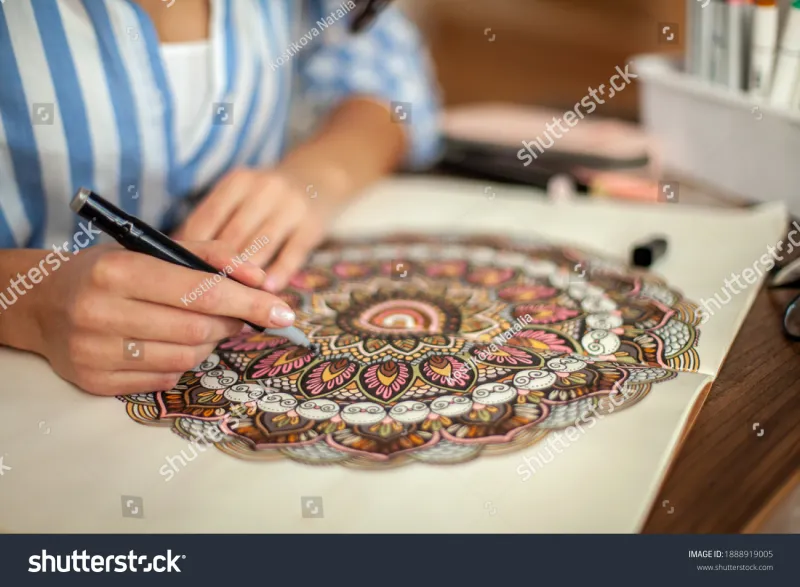
Photo: adult woman coloring intricate mandala page with colored pencils at desk relaxed, via st.focusedcollection.com
The Surprising Wellness Trend Taking Over America's Lunch Breaks
Picture this: a 42-year-old project manager in Chicago, still in her blazer, hunched over a detailed mandala printout during her lunch break. Her coworkers think it's quirky. Her therapist thinks it's genius. And increasingly, neuroscientists are siding with the therapist.
Adult coloring has quietly exploded from a niche hobby into one of the most talked-about mental health tools in the country. Sales of adult coloring books surged past $1 billion a few years back, and digital coloring platforms have seen steady growth ever since. But what's actually happening inside your head when you pick up a colored pencil — or tap a color on your screen? The answer is more fascinating than you might expect.
What's Really Going On in Your Brain
When you settle into a coloring session — whether it's a printable page from a site like Coloring Fun or a digital canvas on a tablet — your brain shifts gears in a very specific way. The prefrontal cortex, the region responsible for worry, planning, and overthinking, takes a back seat. Meanwhile, the areas tied to focus, motor coordination, and sensory processing light up.
Here's where dopamine enters the picture. Dopamine is often called the brain's "reward chemical," but it's more nuanced than that. It's released not just when you finish something satisfying, but also during the process of working toward a goal — especially when that goal involves clear, visible progress. Coloring a section of an intricate design and watching it transform from blank white space into something vibrant? That's a dopamine drip, delivered in real time.
Dr. Sandra Levin, a licensed clinical psychologist based in Austin, Texas, explains it this way: "Coloring gives the brain a structured task with immediate, tangible feedback. Every stroke is a micro-reward. That rhythm of effort and result is genuinely soothing to the nervous system."
Unlike scrolling through social media — which can trigger dopamine spikes followed by crashes — coloring produces a steadier, more sustainable sense of calm satisfaction. Think of it less like a shot of espresso and more like a long, slow cup of chamomile tea that somehow also energizes you.
Why Meditation Apps Aren't Cutting It for Everyone
Meditation is wonderful, and nobody's knocking it. But let's be honest: sitting still with your eyes closed while trying to "clear your mind" is genuinely hard for a lot of people. Research suggests that as many as a quarter of people who try mindfulness meditation experience some form of frustration or difficulty sustaining the practice.
Coloring sidesteps that barrier almost entirely. It gives your restless mind something to do — a gentle anchor — without requiring you to wrestle your thoughts into submission. Therapists have a term for this: "active mindfulness." Your hands are engaged, your eyes are focused, and the mental chatter naturally quiets down without you having to force it.
"I've had clients who tried every meditation app on the market and felt like failures because they couldn't stick with it," says Marcus Webb, a licensed counselor in Nashville. "When I introduced coloring as an alternative, the relief was immediate. They finally had a mindfulness practice that felt natural to them."
Some therapists are now incorporating coloring directly into sessions — particularly for clients dealing with anxiety, PTSD, and burnout — because it creates a low-pressure environment where conversation can flow more freely.
Real People, Real Results
The anecdotal evidence is everywhere once you start looking. Online communities dedicated to adult coloring have tens of thousands of active members sharing their pages, their progress, and their stories.
Tamara, a nurse in Phoenix, started coloring during the pandemic and never stopped. "I work 12-hour shifts. By the time I get home, my brain is fried but I'm too wired to sleep. Thirty minutes with a detailed floral page and I'm genuinely calm. It's the only thing that consistently works for me."
Derek, a software engineer in Seattle, keeps a tablet loaded with digital coloring apps on his desk. "I use it during video call breaks. It sounds weird, but five minutes of coloring between meetings resets my focus better than a coffee walk."
These aren't outliers. A 2021 survey by the American Art Therapy Association found that a significant percentage of adults reported reduced anxiety and improved mood after regular creative activities — with coloring ranking among the most accessible entry points.
The Structure Factor: Why Not All Creative Activities Are Equal
You might wonder: why coloring specifically, and not just doodling or free drawing? The answer comes back to structure. Coloring provides a framework — lines, shapes, a defined space — that removes the anxiety of a blank page while still offering creative freedom in color choice, technique, and style.
For adults who feel intimidated by "real art," that structure is liberating. You don't need talent. You don't need training. You just need a page and something to color with. The creative decision-making — which hues to pair, whether to blend gradients or keep things bold and flat — is enough to engage the brain's creative centers without triggering performance anxiety.
This is also why digital coloring platforms have become so popular. Tools like the ones available on Coloring Fun let users experiment with unlimited color combinations, undo mistakes instantly, and try techniques they'd never risk on a physical page. The low stakes make the whole experience more joyful.
How to Build Your Own Coloring Practice
You don't need to overhaul your routine to get the benefits. Here are a few easy ways to fold coloring into your day:
- Morning ritual: Start with 10 minutes of coloring before checking your phone. It sets a calm, intentional tone for the day.
- Lunch break reset: Keep a printable page or a coloring app handy for midday decompression.
- Evening wind-down: Replace the last 20 minutes of screen scrolling with a coloring session. Your sleep quality may thank you.
- Weekend flow state: Set aside a longer session with your favorite music and let yourself get fully absorbed.
The key is consistency over duration. Even five minutes of focused coloring can shift your nervous system out of stress mode.
Color Your Way to Calm
America's love affair with adult coloring isn't a fad — it's a functional wellness tool backed by real science and real human experience. Whether you're reaching for a printable mandala, loading up a digital coloring app, or gifting a coloring book to a stressed-out friend, you're tapping into something the brain genuinely craves: creative structure, visible progress, and the quiet joy of making something beautiful.
And honestly? That's a pretty great way to spend a lunch break.