Why Picking the Right Color Is Actually a Brain Workout (For Kids and Grown-Ups Alike)
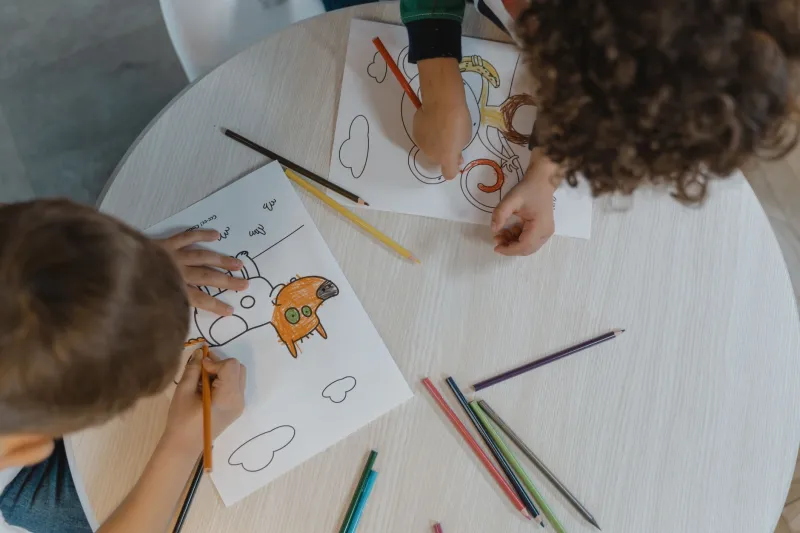
Picture this: you've just opened a fresh coloring page — maybe it's an intricate mandala, a sprawling forest scene, or a goofy cartoon dragon. Before you've even touched a single color, your brain has already started making decisions. Do you go realistic or wild? Start in the center or the corners? What happens if two sections end up clashing?
Here's the thing — that whole internal negotiation isn't just fun. It's a genuine cognitive workout. And at Coloring Fun, we've always believed that creativity and brain-building go hand in hand. Turns out, science is starting to agree in some pretty interesting ways.
The Decision-Making Gym You Didn't Know You Were Using
Coloring might look passive from the outside, but anyone who's actually sat down with a complex page knows it's anything but. From the moment you start, you're constantly evaluating options, testing combinations, and adjusting your approach based on what's working.
Researchers who study creative play have noted that this kind of low-stakes decision-making is actually a powerful training ground for something called cognitive flexibility — the brain's ability to shift strategies, consider multiple solutions, and adapt when things don't go as planned. That's the same mental muscle that helps a kid figure out a tough math problem or helps an adult navigate a tricky work situation.
The beauty of coloring is that the consequences of a "wrong" choice are minimal. You picked a purple that doesn't quite work with the orange next to it? No big deal — you blend it out, pick something else, or lean into the contrast. That trial-and-error loop, repeated over and over across a single coloring session, quietly trains your brain to become more comfortable with uncertainty and more resourceful when faced with obstacles.
How Kids Build Real-World Skills One Shade at a Time
For children especially, the coloring process mirrors the kind of thinking that teachers work hard to develop in classrooms across the country. Consider what a kid actually does when they sit down with a printable coloring page:
- They set a goal. Even if it's just "I want this to look cool," that's intention-setting.
- They plan a sequence. Which section first? What colors do I need nearby?
- They evaluate outcomes. Does this look the way I imagined? What should I change?
- They problem-solve on the fly. Oops, I pressed too hard and the color bled — now what?
Child development experts have long championed open-ended creative activities as tools for building executive function — the set of mental skills that includes planning, flexible thinking, and impulse control. Coloring hits several of those targets at once, especially when kids are encouraged to make their own color choices rather than just following a guide.
Digital coloring platforms like ours add another layer to this. When kids use an online coloring tool, they can experiment with unlimited color swaps without any permanent consequences. That freedom actually encourages more adventurous thinking — they're more willing to try something unexpected because the undo button exists. And that willingness to experiment? That's the foundation of creative problem-solving.
Adults Aren't Off the Hook Either
Let's be honest — plenty of grown-ups assume that once you've got a career and a mortgage, "coloring for brain development" sounds a little silly. But the cognitive benefits don't clock out after childhood.
For adults, the problem-solving element of coloring shows up in some surprisingly sophisticated ways. Choosing a cohesive color palette for a detailed illustration requires the same kind of systems thinking that project managers use when coordinating a team. Deciding how to handle a mistake — cover it, work around it, or embrace it as part of the design — mirrors the kind of adaptive thinking that's valuable in virtually every professional context.
There's also something to be said for the mental state that coloring creates. Psychologists sometimes refer to it as a "soft focus" — a relaxed but engaged mode of attention that's actually ideal for creative problem-solving. When your mind isn't clenched with stress, it makes connections more freely. That's why some of your best ideas seem to arrive in the shower or on a walk — and why a coloring session can produce the same effect.
The Role of Mistakes (And Why They Matter More Than You Think)
One of the most underrated aspects of coloring as a cognitive tool is what happens when things go sideways. A color that looked great in your head turns muddy on the page. A section you thought would be simple turns out to be complicated. The shading you tried doesn't quite land.
How you respond to those moments matters enormously. Research on growth mindset — popularized in US education circles over the past decade — suggests that the ability to view mistakes as information rather than failure is one of the most powerful predictors of long-term success. Coloring creates a natural, low-pressure environment to practice exactly that.
At Coloring Fun, we see this play out constantly. Kids who start out frustrated when their colors "don't look right" gradually learn to experiment, adjust, and sometimes discover that the unexpected result is actually better than what they planned. That's not just a coloring lesson — that's a life lesson in a really approachable package.
Making the Most of Your Coloring Time
If you want to really lean into the brain-building side of coloring, a few small shifts can make a big difference:
Skip the color guides. When pages come with suggested colors, try ignoring them. Making your own palette choices forces more active decision-making and creative thinking.
Try themed challenges. Challenge yourself or your kid to color an entire page using only warm tones, or to make a realistic animal look completely fantastical. Constraints are creativity fuel.
Talk through the process. For kids especially, narrating their choices out loud — "I'm using green here because it feels like the forest is cool and shadowy" — reinforces the thinking skills they're developing.
Embrace digital experimentation. Online coloring tools are perfect for trying bold, unexpected combinations before committing. Use that freedom to push outside your comfort zone.
Revisit finished work. Looking back at a completed page and thinking about what you'd do differently next time builds reflective thinking — another key component of strong problem-solving.
Color Your Way to a Sharper Mind
The next time someone glances over at your coloring page and smiles politely like it's a cute little hobby, you can let them in on the secret: you're actually training your brain. Every palette decision, every course correction, every creative risk you take on that page is building the kind of flexible, resourceful thinking that pays off way beyond the coloring table.
Whether you're helping your kid wind down after school with a printable page or sneaking in a digital coloring session during your lunch break, you're doing something genuinely good for your mind. And honestly? That's a pretty great reason to keep the colors coming.