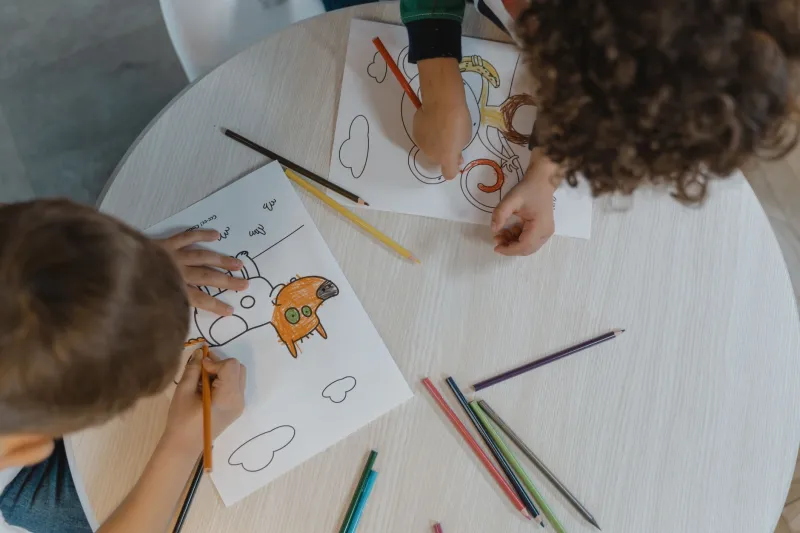
From Fidgety to Focused: How Smart Educators Are Using Digital Coloring to Transform the Classroom

Picture a third-grade classroom in suburban Ohio around 1:30 on a Tuesday afternoon. The post-lunch energy crash has arrived right on schedule. A few kids are slumped over their desks. Others are quietly poking each other with pencils. Their teacher, instead of pushing through the next reading passage, pulls up a coloring activity on the classroom's shared tablets — one that's connected to the science unit they've been working on all week. Within two minutes, the room has shifted. Kids are leaning in, making color choices, talking about what they're creating. By the time the five-minute activity wraps up, they're ready to learn again.
This isn't a fluke. It's a pattern that educators from California to New York are noticing — and the research behind it is more compelling than you might expect.
What's Actually Happening in the Brain During a Coloring Break
Here's the thing about the human brain, especially a developing one: it's not built for sustained, passive attention over long stretches. Cognitive load — the mental effort required to process new information — builds up. When it gets too high, retention drops dramatically. Kids start going through the motions without anything actually sticking.
Coloring offers something genuinely useful in those moments. It's an activity that engages the brain's visual-spatial processing centers and requires just enough focus to interrupt the mental drift, without demanding the kind of heavy cognitive lifting that causes burnout. Neuroscientists describe this as a form of "active rest" — the brain is occupied in a low-stakes, pleasurable way that allows the prefrontal cortex to recover.
There's also a mood component worth noting. Coloring triggers the release of dopamine, the brain's reward chemical. That small hit of satisfaction — especially when a coloring page connects to what students have been learning — can reframe how a child feels about a subject. Suddenly, the water cycle isn't just a diagram in a textbook. It's something they colored in vivid blues and grays and can picture clearly when the quiz comes around.
Teachers Who've Made It Work
Ms. Rivera, a fifth-grade science teacher in the Dallas–Fort Worth area, started incorporating digital coloring activities into her lessons two years ago after noticing that her students retained vocabulary better when they had a visual anchor. "I started finding coloring sheets that matched our units — the solar system, animal cells, ecosystems — and using them as a bridge between instruction and independent work," she says. "It's not downtime. It's processing time."
What she found was that students who completed a short coloring activity after direct instruction performed noticeably better on end-of-week assessments than they had before she made the change. "The kids who struggled the most with sitting still were actually the ones who benefited the most. It gave their hands something to do while their brains caught up."
In a second-grade classroom in Portland, Oregon, teacher Mr. Huang uses digital coloring platforms during morning meeting as a social-emotional warm-up. He assigns a color prompt — "color this image using only colors that match how you're feeling today" — and uses the results as a low-pressure way to check in with students before the academic day kicks off. "It opens up conversations that wouldn't happen otherwise," he explains. "And it settles the room in a way that feels natural rather than forced."
Coloring as a Learning Tool, Not Just a Filler
The key distinction educators keep coming back to is intentionality. There's a real difference between handing out a random coloring sheet to kill time and using a subject-specific coloring activity as a deliberate instructional strategy. When the two are connected, something clicks.
Here are a few approaches teachers are using that you can adapt at home or in your own classroom:
Vocabulary reinforcement through labeling and coloring. Give students a diagram — a map, a plant cell, a parts-of-speech chart — and have them color-code it by category. The act of assigning colors to concepts forces active decision-making, which deepens encoding.
Pre-reading warm-ups. Before diving into a new chapter or topic, a short coloring activity related to the theme primes the brain for incoming information. Think of it as opening a file folder before you start stuffing it with new material.
Post-lesson reflection pages. After a lesson wraps up, a simple coloring prompt — "draw and color one thing you learned today" — gives students a chance to consolidate what they've absorbed in a format that feels rewarding rather than like extra work.
Transition rituals. Between subjects, especially in elementary classrooms, a two-to-three minute coloring break signals to kids that one mental context is closing and another is about to open. It functions like a mental palate cleanser.
Bringing It Home: What Parents Can Do
You don't need to be a classroom teacher to use these strategies. If your kid comes home from school wound up, distracted, or resistant to homework, a short coloring session before diving into assignments can make a meaningful difference. The trick is keeping it connected — if they have a history test coming up, find a printable coloring page related to that era or topic. If they're working on fractions, try a color-by-number sheet that sneaks in some math practice.
Platforms like Coloring Fun make this easier than ever. With a library of themed printable pages and digital coloring tools, you can find something that fits almost any subject or mood in a matter of minutes. The digital format is especially handy for kids who are already on a tablet for homework — it's a screen-based activity that actually gives the brain a break from the kind of screen use that depletes focus.
The Bigger Picture
What's exciting about this movement isn't just that coloring is fun — we already knew that. It's that educators are starting to recognize creativity-based activities as legitimate academic tools rather than guilty indulgences or time-wasters. Color, as it turns out, is a surprisingly powerful teacher.
The classrooms that are getting the best results aren't the ones drilling kids harder or cutting every non-academic minute from the schedule. They're the ones finding smarter ways to work with how young brains actually function — and a well-chosen coloring activity, it turns out, is one of the simplest, most affordable tools in that kit.
So the next time your kid asks to color instead of doing flashcards, maybe let them. Just hand them the right page.