Mix It Up: What Your Brain Is Really Doing When You Blend Colors
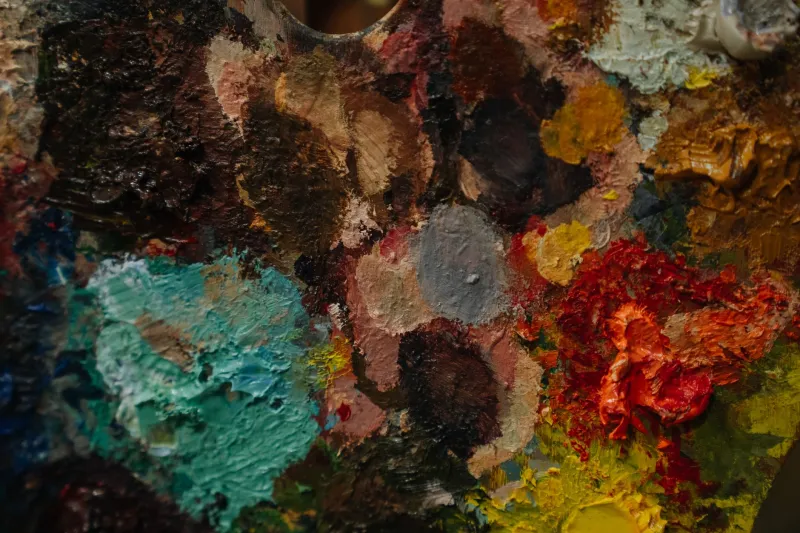
You're sitting down to color. You open your palette, find a nice teal, click, and fill. Easy. Satisfying. Done.
Now imagine a different scenario: you've got blue and green, and you're figuring out how much of each to combine to get exactly the teal you're picturing. You adjust the ratio. You compare it against what's already on the page. You tweak it again.
Both paths lead to teal. But neurologically speaking, they're not even close to the same experience — and the second one is doing something remarkable to your brain.
Two Paths, Two Brain States
When you select a pre-mixed color from a palette, you're engaging a fairly efficient cognitive process. Your visual cortex identifies the color, your prefrontal cortex confirms it matches your intention, and your motor system executes the click. It's quick, clean, and requires relatively little mental heavy lifting.
Blending is different. The moment you start combining colors to create something new, you're activating a significantly broader neural network.
First, your brain has to hold a mental image of the target color — the one you're trying to create. That requires working memory, specifically the visuospatial sketchpad described in cognitive psychologist Alan Baddeley's influential model of working memory. You're essentially keeping a color "in mind" while you work toward it.
Then comes the prediction-and-feedback loop. You make a mixing decision, observe the result, compare it to your mental target, and adjust. This iterative process engages the brain's error-prediction system — the same neural machinery involved in learning any complex skill, from shooting a free throw to playing a chord on the guitar.
"Color mixing is a genuine problem-solving task," says Dr. Lauren Hetrick, a cognitive neuroscientist who studies visual perception and learning. "The brain doesn't treat it like a simple selection. It treats it like a puzzle, and it allocates resources accordingly."
The Role of the Visual Cortex
Your visual cortex — the large region at the back of your brain dedicated to processing sight — does a lot more than just "see" colors. It also constructs expectations about how colors should interact, based on past experience.
When you mix colors, especially in real time on a digital platform where you can see the blend develop, your visual cortex is constantly updating its predictions. What will blue and yellow make? How does adding white change the feel of a red? What happens when you layer a transparent purple over an orange?
Each of these experiments trains your visual system in ways that passive color selection simply doesn't. Over time, experienced mixers develop what artists call "color intuition" — a refined ability to predict color relationships before they happen. That intuition lives in the visual cortex, built through thousands of small mixing experiments.
This is exactly why art educators often insist that students work with a limited physical palette — even when a full range of pre-mixed colors is available. The mixing process is the education.
Color Theory Is Brain Training in Disguise
Most of us encountered color theory in elementary school: primary colors, secondary colors, the color wheel. But the lived experience of mixing — of discovering that red and green make a muddy brown, or that a tiny drop of black can completely kill the warmth of a yellow — is something no diagram can fully convey.
Understanding color relationships at a conceptual level and understanding them through hands-on experimentation activate different memory systems. Conceptual knowledge lives largely in declarative memory — the "knowing that" system. But experiential knowledge, built through doing, encodes in procedural memory — the "knowing how" system. And procedural memory is stickier. It generalizes better. It shows up when you need it.
This is why a child who has spent time mixing colors on a digital coloring platform will often make more sophisticated color decisions — even when using pre-mixed palettes — than a child who hasn't. The blending experience has literally rewired their visual intuition.
What Digital Mixing Offers That Physical Mixing Can't
Here's something interesting: digital color mixing offers a few cognitive advantages that physical paint mixing doesn't.
For one thing, it's reversible. You can experiment with a blend, decide it's not right, and undo it without ruining your work or wasting supplies. That psychological safety encourages more experimentation — and more experimentation means more neural learning loops.
For another, digital tools often let you see numerical values alongside visual results. You can watch as increasing the red channel in an RGB mixer shifts a purple toward magenta, or as adjusting saturation makes a color feel more or less intense. This transparency between the "recipe" and the result creates explicit connections between abstract color theory concepts and concrete visual experience.
"Digital mixing is actually a fantastic teaching tool for color literacy," says Marcus Webb, an art teacher at a middle school in Denver who integrates digital coloring platforms into his curriculum. "Kids can see the math behind the color. They start to understand why certain combinations work and others don't — not just that they do."
Why This Matters for Kids Specifically
Children's brains are in a particularly receptive state for this kind of learning. The visual cortex undergoes significant development throughout childhood and into the teen years, and the experiences a child has during this window shape their visual processing capabilities in lasting ways.
Exposure to color mixing — whether through finger paints, watercolors, or digital tools — during these developmental years builds what researchers call visual literacy: the ability to read, interpret, and create visual information with sophistication.
Kids with stronger visual literacy tend to be better at tasks that require spatial reasoning, pattern recognition, and even reading comprehension (which depends heavily on the brain's ability to process visual symbols quickly and accurately).
In other words, letting your kid spend time mixing colors on a coloring app isn't just fun. It's quietly building cognitive infrastructure that pays dividends across the curriculum.
The Satisfaction Factor
There's also a purely emotional dimension to color mixing that's worth naming: it feels really good when you nail it.
When you've been working toward a specific color — adjusting, comparing, refining — and you finally land on exactly the hue you were after, the brain releases a small hit of dopamine. It's the same reward signal that fires when you solve a puzzle, land a tricky recipe, or finally parallel park on the first try.
That dopamine response is part of why mixed colors often feel more satisfying to use in a finished piece than pre-selected ones. You made that color. It has a history. It's yours in a way that a click from a pre-built palette isn't quite.
Try It Yourself
If you haven't spent much time in the color mixing tools available on platforms like Coloring Fun, it's worth exploring. Start simple: try creating three distinct greens using only blue and yellow, varying the ratio each time. Then try adding a touch of white or black to each one and observe how the character of the color shifts.
Pay attention to what your brain is doing during this process. Notice the prediction, the comparison, the adjustment. That slightly effortful, iterative feeling? That's learning. That's your visual cortex getting sharper.
And the color you land on at the end? That one's entirely yours.