Why the Lines Are the Point: The Creative Superpower Hidden Inside Constraints
Hand someone a blank white canvas and a full set of 120 markers, and watch what happens. More often than not, they freeze. They stare. They second-guess every possible starting point until the whole thing feels less like an invitation and more like a test they didn't study for.
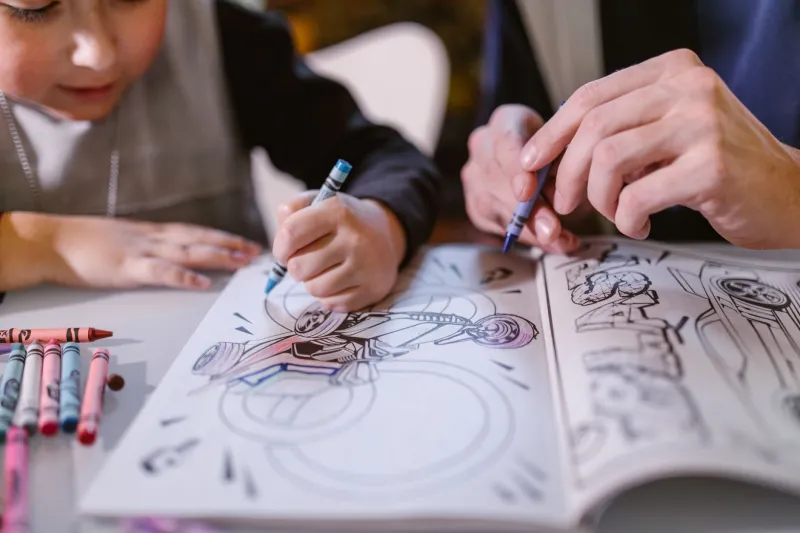
Now hand them a coloring page — clean lines, defined shapes, a clear structure — and something shifts. The pen starts moving. Decisions come faster. Choices feel exciting rather than paralyzing.
This isn't a coincidence. It's psychology.
The Blank Canvas Trap
Creativity researchers have a name for what happens when we face too many options: choice overload. Psychologist Barry Schwartz popularized the idea in his work on decision-making, arguing that an abundance of choices doesn't liberate us — it actually stresses us out and leads to worse outcomes.
The same principle applies to creative work. When everything is possible, nothing feels safe to try. The stakes of every single decision feel enormous because there's no framework to push against.
"Constraints act like a creative scaffold," says Dr. Patricia Stokes, a researcher who has studied how limitations shaped the work of artists like Monet and Picasso. "They don't box you in — they give you something to work with, something to respond to. That's where real creative thinking begins."
For kids especially, this is huge. A child staring at a blank page often shuts down not because they lack imagination, but because they lack confidence in where to begin. A coloring page removes that barrier entirely. The "what do I draw?" question disappears, and suddenly all their mental energy can flow into the far more interesting question: "how do I make this mine?"
The Five-Color Challenge
Limited palettes are another place where constraints quietly supercharge creativity. Many digital coloring platforms — including right here at Coloring Fun — let you experiment with curated color sets rather than the full rainbow. And while it might seem like fewer colors equals less fun, artists and educators say the opposite is often true.
When you're working with five colors instead of fifty, every choice carries more weight. You start asking questions you'd never bother with otherwise: What happens if I use this warm orange in the shadow instead of brown? Can I make this leaf feel alive using only two shades of green?
Those questions are the heartbeat of creative thinking.
Illustrator and art educator Janine Reyes, who teaches color theory workshops across the Midwest, puts it this way: "I give my adult students a five-color limit on their first projects every single time. Without fail, they produce more interesting, more intentional work than when I give them access to everything. The limit forces them to problem-solve, and problem-solving is creativity."
What's Actually Happening in Your Brain
Neuroscience backs this up in fascinating ways. When we work within a defined structure, the brain's prefrontal cortex — the region responsible for planning, decision-making, and goal-directed behavior — gets engaged in a specific, productive way. It's not overwhelmed by infinite possibility; instead, it's focused on optimization within a known space.
This is sometimes called "constrained cognition," and studies have shown it correlates with higher creative output. Researchers at the University of Amsterdam found that participants who worked under constraints generated more creative and original solutions than those given complete freedom. The constraint essentially told the brain: here's your playground, now play.
For kids in developmental stages, this kind of focused creative engagement also builds confidence over time. Completing a coloring page — even a simple one — gives children a concrete, visible win. That win builds the belief that they are creative, which makes them more willing to take risks on the next page, and the one after that.
Adults Get It Too
This isn't just a kids' story. Adults who return to coloring — whether through printable designs or digital platforms — often report feeling a kind of creative relief they haven't experienced since childhood. Part of that is the meditative rhythm of filling in shapes. But part of it is exactly this: the structure gives permission.
You don't have to figure out the composition. You don't have to decide whether the proportions are right. The page has already done that work. Your job is purely expressive — and that freedom within structure is genuinely liberating.
Reyes sees this constantly in her adult workshops. "People come in saying they're not creative. They haven't drawn anything since middle school. But I give them a structured coloring project with a limited palette, and within twenty minutes they're totally absorbed. They forget to be self-conscious. The constraints gave them a safe place to start."
How to Use This at Home (or Anywhere)
You don't need a formal workshop to tap into the power of creative constraints. Here are a few easy ways to try it:
Limit your palette on purpose. Next time you sit down to color — digitally or with physical supplies — challenge yourself to use only three to five colors for the entire piece. Notice how much more deliberate and interesting your choices become.
Try a theme constraint. Pick an unusual color rule before you start: "everything warm," or "only colors I'd find in a forest in October." A theme gives your brain a creative problem to solve, not just a page to fill.
Give kids a single-color gradient challenge. Pick one color and see how many different shades and intensities you can use across a single coloring page. It's a surprisingly sophisticated exercise that teaches a ton about light, shadow, and depth.
Time yourself. Set a ten-minute timer and commit to finishing a small section completely within that window. Artificial time pressure is one of the most reliable creativity boosters out there.
The Takeaway
The coloring page, with its bold outlines and defined spaces, isn't a creative limitation. It's a creative invitation. It says: here's the structure — now show me who you are inside it.
And whether you're six years old picking up a crayon for the first time or forty-six rediscovering the joy of art on a Tuesday night, that invitation is one of the most generous things creativity can offer.
So next time someone hands you a page full of lines and tells you to color within them, don't see it as a restriction. See it as a launchpad.
The constraint is the point. And the point is where everything interesting begins.