Crayons and Calculators: How Coloring Secretly Builds the Math Brain

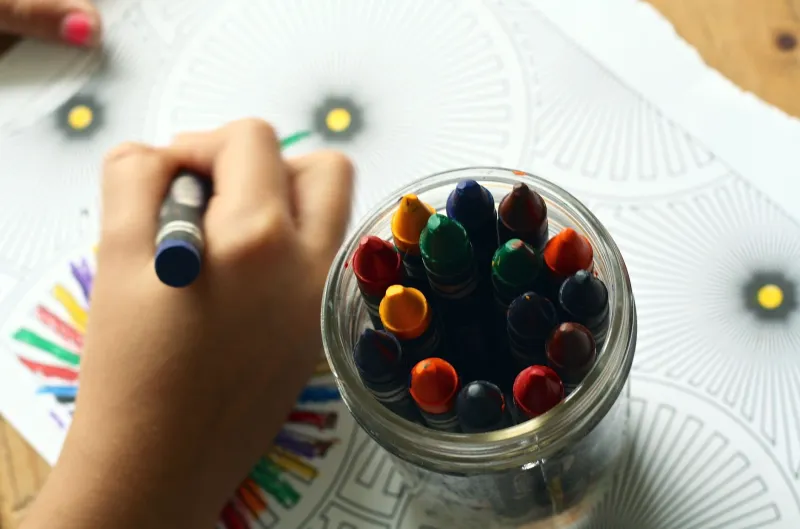
Photo by Photo by gladys rovetta on Unsplash on Unsplash
Here's something that might surprise you: the next time your kid settles in with a detailed coloring page, they might be doing more math than they realize. No worksheets. No number lines. Just a box of colored pencils and a page full of shapes, patterns, and decisions to make.
It sounds almost too good to be true, but educators and cognitive researchers have been quietly building a case for years. Coloring — the kind you find right here on a platform like Coloring Fun — activates the same regions of the brain that handle mathematical reasoning. And the connection runs deeper than most parents and teachers ever expect.
What Does Coloring Have to Do With Math, Exactly?
When most people picture math, they picture numbers. But a huge chunk of mathematical thinking is actually visual. Geometry, spatial reasoning, symmetry, fractions, proportional thinking — these are all math concepts that live in the visual and spatial parts of your brain, not just the number-crunching parts.
Now think about what happens when someone sits down with a coloring page. They scan the image and identify shapes. They notice which sections mirror each other. They decide how colors will relate across the design. They recognize repeating patterns and make predictions about how those patterns continue. Every single one of those mental moves is a math skill wearing a creative disguise.
Dr. Jinfa Cai, a mathematics education researcher at the University of Delaware, has long argued that spatial reasoning is one of the most undervalued predictors of math success in children. And spatial reasoning? That's exactly what you're exercising when you figure out how a mandala is structured or how a geometric coloring page repeats its design across four quadrants.
The Symmetry Factor
Symmetry is one of the clearest bridges between art and math. In a symmetrical coloring page — think butterflies, mandalas, or kaleidoscope designs — the image is divided into mirrored sections. To color it in a way that looks intentional and balanced, you have to understand that symmetry, not just see it.
That means your brain is doing real geometric work. You're identifying lines of reflection. You're predicting what belongs on one side based on what you see on the other. You're essentially solving for an unknown — which is, by the way, exactly what algebra asks you to do.
For younger kids, this kind of visual problem-solving builds what researchers call "geometric intuition," a foundational sense of how shapes behave in space. Kids who develop strong geometric intuition early tend to have an easier time with everything from basic measurement to high school proofs.
Patterns Are Math in Disguise
Pattern recognition is another place where coloring and mathematics overlap in a big way. Mathematicians think in patterns constantly — it's how they spot shortcuts, build proofs, and make predictions. And coloring pages, especially repeating tile designs or decorative borders, are essentially pattern puzzles.
When a child looks at a repeating geometric border and figures out the color sequence, they're doing the same cognitive work as recognizing a number sequence. When they realize that every third section should be blue, they've just worked with a multiple of three. They haven't written it down in a textbook, but the concept is there, alive in their brain.
Elementary school teachers who use coloring activities strategically have noticed this for years. Lisa Harmon, a third-grade teacher in Columbus, Ohio, started incorporating geometric coloring pages into her weekly math warm-ups a few years ago. "The kids who were struggling with multiplication patterns actually started to get it faster once they could see the pattern visually first," she says. "It was like the coloring gave them a way in."
Spatial Reasoning: The Quiet Superpower
Spatial reasoning — the ability to mentally manipulate shapes and understand how objects relate to each other in space — is one of the strongest predictors of success in STEM fields. And it's a skill that doesn't just appear; it has to be practiced.
Coloring is one of the most accessible ways to practice it, especially for kids who haven't yet connected with more formal math instruction. When you're deciding how to shade a three-dimensional-looking geometric design, your brain is working hard to understand depth, proportion, and perspective. When you're choosing which colors to use in adjacent sections so they don't clash, you're making relational judgments about how elements interact — which is spatial thinking in action.
Digital coloring tools add another layer here. On a platform like Coloring Fun, kids can experiment with color fills, undo choices, and try different approaches without any pressure. That trial-and-error process — try something, evaluate the result, adjust — is basically the scientific method. It's also how mathematicians work through problems.
Adults Aren't Off the Hook
This isn't just a kids' story. Adults who color regularly report sharper focus and better problem-solving clarity, and there's some science behind why. Coloring engages the prefrontal cortex — the part of the brain associated with planning, decision-making, and logical thinking — while also activating the creative centers.
That dual activation is kind of remarkable. Most activities engage one mode or the other. Coloring asks both to show up at the same time, which may be why so many people describe feeling unusually clear-headed after a coloring session. It's like a cross-training workout for your brain.
For adults returning to school or working in fields that require analytical thinking, regular creative activities like coloring might genuinely support cognitive flexibility — the ability to switch between different types of thinking fluidly. That's a skill that pays dividends in everything from project management to data analysis.
Bringing It Into Your Routine
So how do you actually use this connection intentionally? A few ideas:
- Choose symmetrical designs when you want to give your brain a geometric workout. Mandala pages and kaleidoscope designs are great for this.
- Try pattern-based pages with repeating tiles or borders and challenge yourself (or your kids) to create a consistent color sequence before filling everything in.
- Talk through the math out loud. Ask your child, "How many sections does this design have? If we color every other one red, how many red sections will there be?" You're doing division and multiplication without anyone groaning about math.
- Use digital tools to experiment. Platforms like Coloring Fun let you try different color combinations quickly, which encourages the kind of hypothesis-testing that's central to mathematical thinking.
The Bigger Picture
We tend to put art and math in separate boxes — one for the creative kids, one for the analytical ones. But that division was never really accurate. The best mathematicians are often deeply visual thinkers. The best artists are frequently more precise and logical than people assume.
Coloring sits right at the intersection of both worlds. It's creative enough to feel like play and structured enough to quietly build real cognitive skills. Whether you're a parent looking for ways to support your child's development or an adult who just wants to keep your mind sharp, picking up a coloring page might be one of the most underrated things you can do.
Grab a page, pick your colors, and let your brain do a little math while you're at it.